Thursday, July 5, 2012

The monkey and the mathematician learn calculus

"Even a monkey can differentiate" - that's how I described the rules based approach that seems to dominate so many students' (and teachers') interaction with calculus. Coming from the "teaching for understanding" camp, I made a very deliberate and careful attempt in my first teaching of calculus to emphasise understanding as opposed to a formulaic, mechanical approach to the subject. And yet - a few weeks later, I've come to embrace my inner monkey.  There is a place for mechanical, automated rule based thinking in mathematics - and I'm now leaning to the view we need to make room for both the monkey and the mathematician.

Here's the monkey at work:

No disrespect - WolframAlpha is an amazingly powerful tool, but it reminds
us differentiation can be done without understanding.

As I worked through the basic rules of differentiation with my class, I found myself continually looking at the rules from the 'monkey' viewpoint as well as the 'understanding' viewpoint.

Differentiation from first principles
Monkey: "Substitute in the values correctly, expand, pray you can factorise out the bottom, then shrink the delta-x to zero." 

Mathematician: Understanding the central principle. The meaning behind every element of the fundamental equation is pivotal - it's like a little prayer in our holy canon. If you have to memorise the formula, you haven't understood it. Visualise the image of the secant becoming a tangent and just write down the description of the process: $f'(x) = \lim_{\Delta x \to 0}\frac{f(x + \Delta x)-f(x)}{\Delta x}$. OK - now release your inner monkey and finish the work.

The Chain Rule
An exploration using Marc Renault's amazing Chain Rule analogy interactive gives our mathematician side a boost here. For our monkey side, we developed the language of 'inside' and 'outside' to describe composite functions - modelled on Russian dolls.  Here's how I summarised the two approaches:

Click on the image for a larger view
The Product Rule
I'm a big believer in showing the geometric justification - and it's more credible than the limits sleight-of-hand  pulled by high school text books. That's for the mathematician. For the monkey, we learn the rule - and I like a cross-product type visualisation:
Click on the image for a larger view
The Quotient Rule
Last but not least, the quotient rule. I think it's important for the mathematician to see the connection to the Chain Rule and the Product Rule ("so that's why there is squared in the denominator!")  For the monkey - well it's another pattern to get into the habit of using:

Click on the image for a larger view

Who's more important: the monkey or the mathematician? As much as I initially laughed at my inner monkey, I've come to value him. I don't think we need to choose between the modes of working - there is value in both. I suspect it's about 'reducing cognitive load' - with a reliably functioning monkey, we can perform low-level functions without too much thought, saving our awareness to concentrate on the more  complex ideas at hand.  The only danger with that monkey is too many bananas and we can forget the meaning behind the operations....

Saturday, June 23, 2012

The wisdom of Year 7 : thinking about groups

It's been nearly a year now since I changed my classroom configuration from rows to groups:


Overall I'm very pleased with the results - it's working for almost every class. The one class where I have wondered if I should revert to rows have begged me not to - challenging me to think more deeply about my classroom management for this class - I'm working on it! But there is no looking back now. These insightful comments from my Year 7 students, given as anonymous student feedback, reveal the benefits and challenges of setting up group tables.

Group Table Configuration : The Good
"Helps with learning because always someone u can ask 4 help"
"You can ask for help when the teacher is busy"
The group configuration helps deal with the challenge of answering questions from thirty students at once. Sometimes the group may come up with the wrong answer - but I rarely see this happen and am much more likely to detect any misconceptions if four students share them. What I do see on many occasions is students debating the answer, and they will ask for help if they aren't sure of their answer.

"Interesting learning from different perspectives"
Students discover how their peers view and understand the content - enriching their own understanding, and providing opportunities to develop metacognition : becoming aware how knowledge is obtained and processed.

"Let's me compare my answers and help people"
A powerful gift to offer to students : creating an environment for helping each other - developing generosity. One of my four pillars from the Circle of Courage.

"It helps cos if u don't understand something and 2 shy 2 ask u can ask ur friends" 
Wow! How many students are held back because of this? A powerful insight on how a group table structure can help overcome emotional, personal and social barriers to learning.

"No need to be a loner - there are people around to help and support"
"Being alone is lonely"
How can we know the emotional needs of all students - let alone be able to help thirty students? Sitting students together, supporting them during class time to be together may just turn out be very important to some students who might be alone at other times. I was moved to read these comments.

Group Table Configuration: The Bad
"I would like to sit with different people"
I'm still uncertain if it's best to organise students or let them self-select groups. I worry about bullying and social exclusion, allowing students to set up hierarchies "you are in my group, you aren't". For now my answer is I assign the groups for Year 7 and Year 8 - and consider any problems on a case by case basis. A part of me also thinks it's important I maintain control of the seating.  Any ideas welcome!

"I can never see the board properly"
Ouch. This is the biggest issue  - and I think it's serious - especially since perhaps 30% of my lesson time is whole class instruction. Research that argues for sitting in rows claims this is the major problem with the group configuration. There are four seats in my configuration where this is a problem. I wish my classroom was wider to optimise the layout, but some tables don't get a good view of the board. I'm now going to establish it as a norm that those four students to turn their chairs to face the board during whole class instruction.

"Sometimes people just give you the answer"
An insightful comment from one student! Group configuration discourages solitary work - which is essential at times - and allows for students to just give each other answers. I often use an A/B/C/D paper approach to ensure each student at the group table has a different set of problems to work on - getting help has to be real help, not answers. But time doesn't always permit this, and if we are using the textbook, they are working on the same questions. I think I will need to be more explicit with students about ways of helping to maximise the learning.

Something not mentioned in the feedback is groups can encourage off-task behaviour and conversation. Fortunately with this class, that's not a problem - when they do go off-task (they are students!) they respond quickly  to my request to get back to mathematics. This isn't the case with all my classes - more on that in another post.

The Verdict?
Unquestionably (for me) : Yes. The learning and social benefits are so high, it's worth persisting to deal with, or minimise the down sides.  I'm looking forward to seeing how the comments next week from the class where I am having some class management issues will compare to those quoted above.

Note: My student feedback forms have an Opt-In indicator "Tick if you are OK for these comments to be shared with others". The forms themselves are completely anonymous, allowing for students to give me frank feedback without concern for any consequences.

Monday, June 11, 2012

It's trigonometry Jim, but not as we know it!

Do you remember high school trigonometry? Was it a blurred sequence of formulae with a recipe book of incantations for solving standard exam questions? I'm afraid to say that was my experience and it has taken many years (decades!) for me to see the full beauty and unity of the subject. Teaching it for the first time this year I was determined not to inflict the same on my students. My attempt at something a little different was based on a few key metaphors and heavy use of diagrams and graphs, supported by stories to help students see why trigonometry is indeed an interesting study for scientists, mathematicians and historians.

Forget triangles - let's cast a horoscope!
In senior school trigonometry, we're not just playing with triangles any more. Welcome to the weird and wonderful world of circles and periodic functions. I think a good way to introduce the unit circle is to place it in the historical context of our ancient star gazers watching the heavens. That's our unit circle: the night sky. I suspect our ideas of angles, triangles and projections onto a circle owe as much to calculating the pharaoh's horoscope as they do to measuring irregular sizes strips of land to work out the taxes owed him.

Trigonometry : was it really about casting the daily horoscope?
Celestial dome cartoon (inset) from http://www.herongyang.com/astrology_horoscope/Astronomy_The_Celestial_Meridian_and_Zenith.html  

Now that we have the idea of the rotating angle, and students see (or better yet explore) the sine curve, I think it's well worth showing why this is such a relevant and powerful idea. Share with students some of the interesting physics - show wave motion, show how different light frequencies relate to different colours. Hint at the mathematical treasures that await them: I showed some pictorial sequences introducing Fourier analysis. Trigonometry is about so much more than triangles - and it's relevant, interesting and surprising.

Round about and round about we go : the trigonometry carousel
A powerful metaphor for explaining the rotating angle and the periodicity of trigonometric function is the carousel:

Think of the rotations around the unit circle like riding a carnival carousel.
Carousel photo CC-BY-NC- SA http://www.flickr.com/photos/jaremfan/3478916095/
Carousel horse photo CC-BY-NC-SA 
http://www.flickr.com/photos/birminghammag/6045458462/ 
This emphasises the periodicity of the rotation and allows extension to the idea of spinning faster, going from $\sin(x)$ to $\sin(3x)$, or slower, $\sin(\frac{x}{2})$, and then spinning wider to $5\sin(x)$.

Draw a diagram!
At this stage I believe it's worth spending quality time looking at the different graphs of $\sin(x), \sin(3x), \sin(\frac{x}{2}), 5\sin(x), 5\sin(3x)$. This helps visualise the functions and helps avoid the problems we seen when students start working with $\frac{\sin(3x)}{3}$.  Time also to bring out your function machine analogies and emphasise that $\sin()$ is function operator - not a multiplication of $\sin \times x$.

When it comes to solving trig equations, so many text books are filled with pages of algebra and barely a single diagram. Want to really understand the equation $4\sin(3x) = 1$ in the range $0^\circ \leq x \leq 180^\circ$ ? Draw the graph (sketch or use your favourite graphing tool):

Now we have many stories to tell! Why are there so many solutions? Because your students understand we have periodic functions (riding the carousel) and have seen the difference between the graphs of  $\sin{x}$ and $\sin{3x}$ the reason for all those solutions becomes less mysterious. And a quick sketch can help check the solutions. Drawing the graphs of trig equations also reinforces the difference between equations (sometimes true) and identities (always true) - another source of confusion when students start trigonometry at this level.

A helpful place to use graphs is when teaching the Auxiliary Angle transformation of $a\sin(x) + b\cos(x)$. Remarkably, very few textbooks show the graphs. I started with the graphs: looking at the unexpected result that when we add a $sin()$ curve to a $cos()$ curve, we get another periodic function - just with a different amplitude and a slight phase shift.


Yes - that's physics coming in - I share this language with the students - many of them are studying physics. Once you show this remarkable graph, actually working out the equations for the transform is straight forward and it makes sense - it's not just abstract symbolic manipulation.

Trigonometric Identities : Same person, different clothes
A helpful metaphor to distinguish identities from equations (why oh why do we do regularly use the same equals sign to mean different things?):

Same equation, different clothes.
Superman/Clark Kent graphic by Ian MsQuee
http://ianmsquee.deviantart.com/gallery/3370060?offset=24#/d1onlf2

Later, when it comes to teaching the transformations, I add in the telephone box:

The half-angle t-transform helps Superman transform back into Clark Kent.
And Clark Kent is easier to pin down (solve) than Superman!

Trigonometry at this level really is a lot of fun - it brings together many different ideas and skills, producing some beautiful and unexpected results. And so many more wonderful surprises to come for those students who will later visit the world of complex numbers! Hopefully we can share that wonder with our students, so they don't just view trigonometry as a set of definitions, formulae and algebraic manipulations, but instead develop a strong intuitive feel for working with the circular functions.

And don't forget the graphs - or as a colleague repeatedly tells her class "DRAW IT!"

Some Teaching Resources

  • The Maths 300 "Trigonometry Walk" lesson (subscription required - but an internet search will find you some worksheets) is an outdoor exercise that helps students get a strong sense for the idea of projecting onto the unit circle.
  • James Tanton's whimsical Squine and Cosquine presentation explores what would happen if we used a unit square instead of a unit circle. Perhaps save after students have consolidated the knowledge?
  • Vi Hart's 13 minute video "What is up with noises?" is a wonderful exploration of the physics of sound, music and hearing. A little long to fit into a busy schedule, but good for a rainy end-of-term day.

LaTex in Google Blogger

Thanks to this post on A Rambling Soul I now have easy-to-use built in LaTex in this blog!

So now I can write $ax^2 + bx + c = 0$ and $\frac{ \sin{x}}{\cos{x}} = \tan{x}$ without pain!

For Google bloggers: you will need to go into the template and select the option to directly edit the HTML template.

Saturday, May 26, 2012

Countdown to Transit of Venus

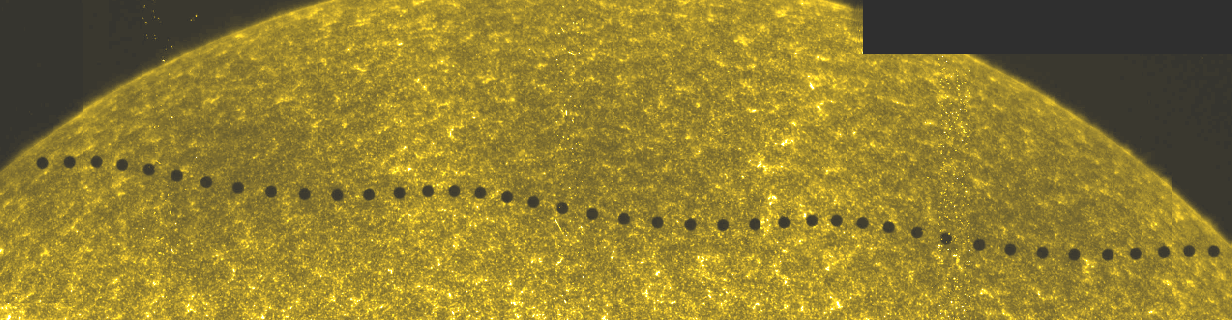
A curious composite image from the TRACE solar observation satellite, watching the planet Mercury move across the sun in 2003.

Parallax shift as recorded by TRACE satellite (orbiting Earth)
 recording the Transit of Mercury 2003.
Image source   http://trace.lmsal.com/POD//  
No - Mercury isn't wobbling ... it's the satellite taking the photos that is moving, orbiting Earth on a North-South path. Mercury thus appears to move up or down, depending whether the satellite is North or South of the equator when the image is taken.  While man-made satellites able to photograph Mercury passing the sun are relatively new, people have been measuring the parallax shift during the transit of Venus since 1761 by sending observers to different points across the globe. Australians feel a particular affinity with the Transit of Venus: measuring it was a key motivation for Cook's voyage on the Endeavour.  In two weeks, Venus does it again - the last chance to see it in your lifetime. Australian students and their teachers are particularly fortunate as the ToV event starts and ends with the school day on June 6th.

Looking for activities to do with students? http://transitofvenus.org/ has an impressive one-stop collection of resource links. With so many to choose from, here's a short list we are using in our mathematics faculty to prepare students for watching the event:
  • Two videos we found to be high both engaging and high quality, with mathematical content suitable for all ages:


If you like the idea of using satellite imagery to demonstrate the parallax shift, it's interesting to compare image from TRACE (which does orbit the Earth), to that taken by SOHO (which does not orbit the Earth):

No parallax shift from SOHO images!
Transit of Mercury 2003. Photo: NASA.


Saturday, May 12, 2012

Still alive ...

It's been a long time between posts .. but rest assured I'm still alive - just swamped by teaching right now. Hope to write some more soon on the following topics:
  • Useful metaphors for teaching senior trigonometry
  • Ideas our school is doing for the Transit of Venus 2012 - with some resources
but in the meantime ...


A notice to all new teachers: Get yourself to the doctor ASAP and get vaccinated for whooping cough. Yes - you probably got vaccinated as a child, but immunity only lasts 10 years.   I really really wish someone had told me to do this. Yes - I caught it - most likely from someone at school - I have only just stopped coughing after three months of hacking. And even worse, I could have spread it around. Fortunately my doctor picked it up and gave me the treatment to stop it being infectious. Sadly the treatment doesn't cure the cough - making for a very unpleasant time the last few months. As a new teacher you are particularly vulnerable to catching and spreading the disease. In New South Wales, Australia, there are 20,000 cases diagnosed per year - and probably many many more go undetected - because adults just put up with it. The vaccine is normally combined with a Tetanus booster - just do it!

Tuesday, April 3, 2012

TeachMeet East At Kambala

A great way to get inspired: catch up with other teachers at a Teach Meet - come join the movement! Organised by teachers for teachers, Teach Meet seems to be really taking off in Australia.  Thanks to the teachers at Kambala school for hosting us tonight. 

My contribution:
The Function Zoo a Group Exploration Lesson Design v5 Annotated

This lesson is also available for free download at Maths Faculty