Saturday, October 13, 2012

Polynomial stories

What's not to like to about polynomials? They look amazing - and they are just great fun to play with - especially if you have dynamic graphing software to explore their shapes. Here are a few teaching ideas I developed over the last few weeks.

First and foremost we need a character : meet Polly the Amazonian parrot. There's a reason she is from the Amazon... you'll see soon.

Amazona agilis by Jacques Barraband(1767-1809)
http://commons.wikimedia.org/wiki/File:Amazona_agilis_-_Barraband.jpg

Polly featured throughout my lessons - my favourite was the zero polynomial $P(x) = 0$

Reminds me of a Monty Python sketch ....

and later when we looked at taking the second derivative, then the third, fourth, and fifth derivatives - the disappearing Polly:

The Disappearing Polynomial

I'm a big believer in having 'characters' to help teach mathematics - I think they act as 'mental anchor points' to help link related concepts, and then make high level linkages across topics more visible - as in the example above of the disappearing polynomial.

Then we need to explore the properties of polynomials. If we have a quartic polynomial, how does its graph change if we change the roots? I got a good response to my students with this homework exploration tool - I used it for a 'flipped' lesson:
Lesson 02 FLIPPED Graphs of Polynomials

Early on in the presentation of polynomials, I think it's a good idea to show some of the interesting applications:

Using polynomials for modelling. I used this example of a photograph of the Amazon river, loaded into GeoGebra, fitted to a polynomial using the FitPoly function.  Why would we want to do this? I suggested in this case, having an equation for the Amazon River could help us model water flow - perhaps helped by working out the gradient function:

Amazon River – photo from NASA. 
Curve fitting using GeoGebra FitPoly[] function.   
http://commons.wikimedia.org/wiki/File:Amazon_57.53278W_2.71207S.jpg

Using polynomials to approximate other functions: A good time I think to introduce the Taylor Series:


No need to go into deep explanations - just show what is possible with polynomials. I returned to this idea in the next topic when showing higher derivatives, and have another visit planned when we do complex numbers to help demonstrate the famous Euler Formula.

And finally, after demonstrating the closure of polynomial operations for addition, subtraction and multiplication, students may find it interesting to learn about the role polynomials play in many encryption systems.


I looked hard for an online paper suitable for advanced high school students - the best I have found so far is Christopher Cooper's notes for his "Languages and Machines" course at Macquarie University.


More GeoGebra HowTo Sheets

Thursday, October 4, 2012

Newton and Descartes channel Dan Meyer

There's a definite pause the first time you show parametric equations to  students well conditioned to Cartesian representations.  I like to imagine Descartes himself staring at the equations pondering : "Why would you do that????"

We're not in Kansas any more!
Descartes: "Why would you do that? It's the same end result!"
Here are three teaching ideas I used this year with my senior mathematics class which may supplement the traditional approach of showing the different representations are functionally equivalent.

1. Extend the function machine idea to show a weird new parametric function machine. Now we have two outputs!  Here are the two function machine images I use for my resources:

Based on a function machine diagram at http://raider.mountunion.edu/ma/MA125/Fall2011/Chapter7/IntroToFunctions.html
I removed text from the original image, then adjusted it to make the parametric machine.

2. Explore the reasons why we might want to use parametric expressions to describe a relationship. 

The best I answer I came up was this (click on the image for a larger view):

Newton and Descartes ponder Dan Meyer's "Will it hit the hoop" lesson.
My students did this activity in a previous lesson, so they got the joke.

In other words, a parametric description of this scenario lends itself to a deeper understanding of the physics of the situation. 

Another reason for using parametric equations is that the maths can be much more interesting - and possibly a lot easier to work with.  Parametrics also give us another way to get a feel for the constraints at work in a locus.  I love this wonderful "move the robot" explanation from James Tanton - and it speaks to my IT background where parameter go in, and things move accordingly!


3. Get a feel for parametrics by controlling the parameter using dynamic geometry software.  I found it really helped my students to build a parametric representation, then adjust the parameter by moving sliders and then seeing points move under their control. Actually touching and moving and parameter reinforces the idea of a point travelling along a path under a constraint.  Here is a resources for students to explore parametric representation of the parabola using GeoGebra:


HowTo Guide: Exploring the Parametric Representation of the Parabola

This guide is part of my collection at GeoGebra HowTo 

Saturday, September 22, 2012

Toys and tools for exploring the Parabola

Following on from three ideas to introduce locus, here are three ideas I used to help make the locus of the parabola come alive for my students. Regular readers of this blog will know how much I believe in the benefits of hands on exploration of mathematical objects - and these are very hands on!

The three ideas are:
  • Use a MIRA mirror to construct a parabola. My senior students loved this activity- a chance to revert to back to childhood, while still being challenging.
  • Use GeoGebra to construct a parabola given any arbitrary focus point and directrix. Try this with non-standard orientations.
  • Be entranced by a wonderful 3D optical illusion toy that exploits the properties of the parabola.

1. Using a MIRA mirror (MIRA math tool) to construct a parabola
I'm extremely fortunate to have a box of these in my faculty storeroom:
Source:  http://www.enasco.com/product/TB14953T 
While they look like tools for the junior math room (and they are wonderful to use in this context!), there's no reason our senior students should be locked out from using them! Here is a worksheet that give instructions on constructing a parabola with the MIRA mirror.  It's a really fun activity - a chance for senior students to play a little - and a great opportunity to ask the "why" question - reinforcing the idea of locus and the locus definition of a parabola.

Locus and Parabola MIRA Parabola GHT0501

2. Constructing a parabola using GeoGebra.
Why do I need special help to construct a parabola in GeoGebra you may say? Of course GeoGebra can construct a parabola with zero effort. But this guide explores how to construct a parabola using the locus approach.


Can you find the parabola given any arbitrary focus
point F and directrix AB?

Locus and Parabola Make a Parabola GHT0301

3. Discover something special about the parabola
A terrific toy worthy of being in your mathematics (and science) classroom is the Optigone Mirage®.

The Optigone  Mirage® is a pair of twin parabolic mirrors, arranged to project
a 3D image floating above the top of the kit. In this image from a paper by Christian Ucke,
the pig is actually inside the mirrors.
As always, encourage students to play with the toy (not that they will need encouragement - my students had their smartphones out takings photographs within seconds!), then ask the Why? question. Even though I purchased* one of these for my senior mathematics class, students across all my classes were entranced by it - and it gave me great pleasure to say to the juniors "you will learn how it works in your maths and science classes in a few years".

* Sadly I could not find a convenient way to purchase one of these in Australia - so I ended up buying a  clone from Australian Geographic.

Sunday, September 9, 2012

How do you do that in GeoGebra?

Looking back on my own high school mathematics education, I realise I never really knew what a parallelogram was. I never knew how it 'worked', how its angles and diagonals operated, how they changed when the slope of the parallel lines was changed. The rhombus? All I could really say - if I remembered it at all - was it was a kind of squashed up square. If only I had  been given a dynamic geometry tool to play with! As a teacher now, I strive to have my students actually touch mathematical objects - to move them, push them, pull them, to watch what happens. I'm convinced that if students do that, so long as they are reflecting on what is happening to the objects (and why), they will remember them for life.  And the ideal tool for hands-on interaction: GeoGebra.  Free software, runs on Windows, Apple and Linux (anything that runs Java), backed by a community of hundreds of thousands of teachers using and sharing GeoGebra resources.

A resource I haven't found yet though is a set of simple, one page instructions I can give to students showing how to construct a certain mathematical objects in GeoGebra, so I have begun building some.

Here's the first installment:

For Junior and Middle School
How to construct a rhombus. This one appears simple but can be confusing - practice it first before giving to students.
For Senior School

I have put these links on a new GeoGebra HowTo page in this blog. These files are also available at the Maths Faculty sharing repository.

Saturday, September 1, 2012

Three teaching ideas for introducing locus

Here's three ideas I use for introducing locus.

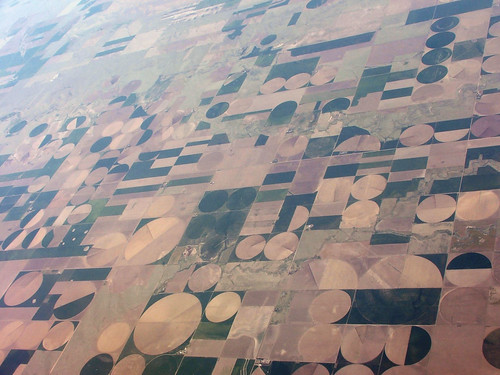
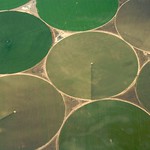
1. What makes these shapes? Have you ever looked down from an airplane window and seen a sight like this? Something you will often see above large scale farming areas:

Mid-West Agriculture
Centre Pivot Irrigation - an example of locus of the circle.
Photo: Etienne Boucher CC-BY-BY-NC-SA 
Give the students some time to digest these images - you will hear lots of wild theories.

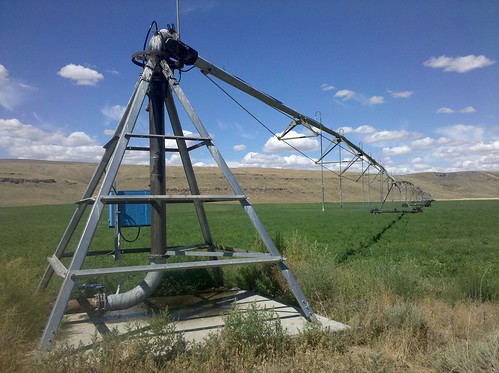
Then show this picture and see if they can work it out:

Center-pivot irrigation
“Centre Pivot Irrigation” Matt Green CC-BY-NC-SA
The Wikipedia page on Centre Pivot Irrigation has lots more interesting information.

2. Acting the Goat.  Tie yourself with a rope to a chair or desk and pretend to be a goat. Explain how goats will eat absolutely everything in sight. Model the behaviour. A good laugh - and your class won't forget the locus of a circle or the concept of a constraint determining the locus. Then extend the idea to different situations of a goat on a leash (tied to a fence with a sliding leash, etc).
Built the idea of a locus by "acting the goat".

3. Who cares about locus?  Show an image like this:

Astronaut Stephen K. Robinson, STS-114 mission specialist, 
anchored to a foot restraint on the International Space Station’s Canadarm2.
Photo: NASA
 http://spaceflight.nasa.gov/gallery/images/shuttle/sts-114/html/s114e6647.html

This person certainly cares about locus! Also a good opportunity to raise awareness of the International Space Station. More information on the Canadarm2 at http://science.nasa.gov/science-news/science-at-nasa/2001/ast18apr_1/

I said three ideas? Sorry - I can't resist sharing three more ...

4. "Locus Pocus" : A high quality video about locus well worth showing in class is Erica Morabito's Locus Pocus.


I like this video because it creates some memorable visual representations of specific locus problems that students need to know while also being entertaining and succinct (lesson time is a precious resource!).

5. Introduce the ellipse : Most students have an idea what an ellipse is, but very few know how to make them or the locus idea behind them. This YouTube clip give a good demonstration:


and I wrap up this discussion with a picture of my favourite example of an ellipse in action:

Locus of the ellipse at work in the universe:
a stunning NASA image of Io orbiting Jupiter.
http://www.nasa.gov/mission_pages/juno/multimedia/pia02879.html
Yes - another segue into astronomy.  Locus is manifest throughout our universe - it would be remiss of us not to show such stunning images of it at work.

6. Work the Geometry 'vs' Algebra dynamic: I find it helps students to be explicit about the two different approaches to curves (geometric versus algebraic). It seems to me many students prefer the algebraic - so we need to work extra hard to show the virtue and value of the locus view. I reintroduce our fellow travelers Euclid and Descartes and show the dynamic at work - that we want to be able to switch between them with ease.

Every time I have an idea or problem to develop with the class, I invoke the Euclid/Descartes duo. It's fun to have great mathematicians in the classroom with you - and it helps develop a broader of mathematics as a dynamic, developing intellectual inquiry - something students can participate in and perhaps even extend.

Next post in this sequence: Teaching ideas for introducing the locus of the parabola.

Saturday, August 25, 2012

Moves in translation with Miss Anna Parabola

Some concepts are so powerful in mathematics, they just keep popping in your course again and again - like old friends. Such an idea is the translation of a curve in the number plane. In my class, this old friend has a name: Miss Anna Parabola. Anna has been making an appearance throughout my course, starting off with an introduction to the quadratic function.

Miss Anna Parabola demonstrates $y = x^2, y = -x^2, y = x^2 + k$.
Ballerina: Alicia Alonso in 1944, photographed by Gjon Mili for Life magazine

I will admit to raising and lowering my arms in the different ballet positions in class, standing up on chairs (against OH&S regulations ....) - but I vehemently deny donning a tutu. 

I knew I was onto a good thing when I started teaching the topic "Locus and the Parabola". One of our textbooks spends an arduous 35 pages (no kidding) going through all the iterations of the different orientations and translations of the parabola - but I realised with our class understanding of Miss Anna's dance moves, we could collapse the entire thing into two lessons: one lesson to cover the different orientations, one to cover the translation.

The Four Standard Orientations of the Parabola -
as interpreted by Miss Anna Parabola (aka Alicia Alonso)
(Click image for a larger view)

Translating the vertex.

And it worked : my students can now do this effectively and efficiently. They connected our previous work on shifting curves like $x^2 + y^2 = 25$ to $(x-2)^2 + (y+4)^2 = 25$ to this work on shifting the parabolas. We cracked what would otherwise be a very arduous (and boring) part of the topic by focusing on the key idea of 'moves in translation'.   I'm a big fan of creating characters and story to build a narrative in the course, so I was thrilled to see the work from previous topics developing Anna Parabola pay off like this.

Oh - and in case you haven't heard of him, Anna has a new friend: Billy the goat. Billy helps develop the idea of locus : if you tied him to a fence, he would happily devour everything around him, following the locus constraint imposed on him.  And yes - I do admit to tying myself to a desk and 'acting the goat'.  How am I going to live this down....?

PS: I'm not sure this trick would work at a boys' school.... Might have to invent a rugby player in motion...

Sunday, July 22, 2012

Art photography in the maths classroom - thanks to flickr

So much of the mathematics content we teach appears to many students to be fairly dry on the surface - we hope we bring them on the journey to see its wonder, but there is nothing like a great visual to create interest and start a quality discussion. Recently I tapped into an amazing resource: flickr photos provided under Creative Commons licenses.  There are thousands of high quality inspirational photographs available just waiting to go into a mathematics lesson.

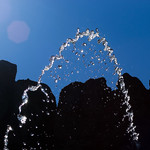
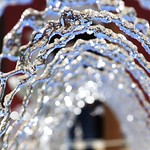
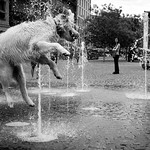
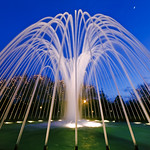
For the topic "The Quadratic Function", water was my visual theme. I use just one of these images for each lesson - we start the lesson with a full screen, high definition version and then I use smaller versions to create a visual link for transitions between lesson activities.

Water is Life water and light parabloa?
frozen moment chasing water I Fuente // Fountain
All images under Creative Commons. Click on the photograph for details.

For the topic "Locus and the Parabola" I blended an astronomy theme (think: parabolic reflectors) and more abstract designs:

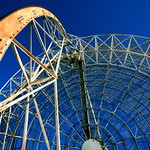
Outreach North of Umatilla A fly's eye view Is a Flickr image good if its thumbnail isn't? Curly Wurly rope handsome antenna Tangents Marinos Ices Mixture
All images under Creative Commons. Click on the photograph for details.

These images look spectacular in high definition projected onto a screen in class - and give an opportunity to engage in some broader discussion about the application of mathematics, and the relationships between art, science and mathematics. Interesting to see students also noticing the use of Creative Commons - a chance to model good practice and spread the CC message.

Because the creators of these images generously put their work 'into the commons',  I can use them in my own works and then in turn, share those works with other teachers without any copyright constraints - hopefully helping students in many other classes.

Finding Creative Commons licensed content on flickr
Use the Advanced Search feature:


scroll down and select these boxes:


I also select "Interesting" which tends to return richer images. When using the image, make a CC attribution and provide a link back to flickr page. I also like to leave a thank you comment to author. And thank you flickr for coming to the CC party. Now if only Google would make CC searching available on its main image search page! I believe it is there - just hidden - and life is too short to look for hidden options.