Saturday, May 26, 2012

Countdown to Transit of Venus

A curious composite image from the TRACE solar observation satellite, watching the planet Mercury move across the sun in 2003.
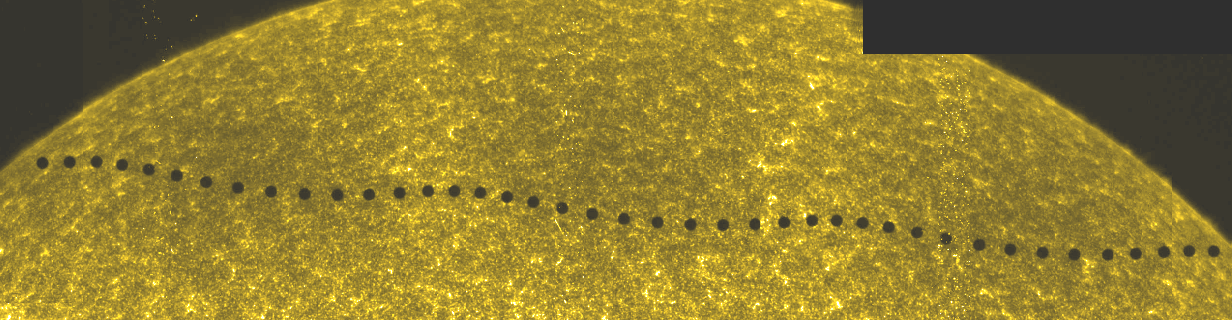
Parallax shift as recorded by TRACE satellite (orbiting Earth)
 recording the Transit of Mercury 2003.
Image source   http://trace.lmsal.com/POD//  
No - Mercury isn't wobbling ... it's the satellite taking the photos that is moving, orbiting Earth on a North-South path. Mercury thus appears to move up or down, depending whether the satellite is North or South of the equator when the image is taken.  While man-made satellites able to photograph Mercury passing the sun are relatively new, people have been measuring the parallax shift during the transit of Venus since 1761 by sending observers to different points across the globe. Australians feel a particular affinity with the Transit of Venus: measuring it was a key motivation for Cook's voyage on the Endeavour.  In two weeks, Venus does it again - the last chance to see it in your lifetime. Australian students and their teachers are particularly fortunate as the ToV event starts and ends with the school day on June 6th.

Looking for activities to do with students? http://transitofvenus.org/ has an impressive one-stop collection of resource links. With so many to choose from, here's a short list we are using in our mathematics faculty to prepare students for watching the event:
  • Two videos we found to be high both engaging and high quality, with mathematical content suitable for all ages:


If you like the idea of using satellite imagery to demonstrate the parallax shift, it's interesting to compare image from TRACE (which does orbit the Earth), to that taken by SOHO (which does not orbit the Earth):

No parallax shift from SOHO images!
Transit of Mercury 2003. Photo: NASA.


Saturday, May 12, 2012

Still alive ...

It's been a long time between posts .. but rest assured I'm still alive - just swamped by teaching right now. Hope to write some more soon on the following topics:
  • Useful metaphors for teaching senior trigonometry
  • Ideas our school is doing for the Transit of Venus 2012 - with some resources
but in the meantime ...


A notice to all new teachers: Get yourself to the doctor ASAP and get vaccinated for whooping cough. Yes - you probably got vaccinated as a child, but immunity only lasts 10 years.   I really really wish someone had told me to do this. Yes - I caught it - most likely from someone at school - I have only just stopped coughing after three months of hacking. And even worse, I could have spread it around. Fortunately my doctor picked it up and gave me the treatment to stop it being infectious. Sadly the treatment doesn't cure the cough - making for a very unpleasant time the last few months. As a new teacher you are particularly vulnerable to catching and spreading the disease. In New South Wales, Australia, there are 20,000 cases diagnosed per year - and probably many many more go undetected - because adults just put up with it. The vaccine is normally combined with a Tetanus booster - just do it!

Tuesday, April 3, 2012

TeachMeet East At Kambala

A great way to get inspired: catch up with other teachers at a Teach Meet - come join the movement! Organised by teachers for teachers, Teach Meet seems to be really taking off in Australia.  Thanks to the teachers at Kambala school for hosting us tonight. 

My contribution:
The Function Zoo a Group Exploration Lesson Design v5 Annotated

This lesson is also available for free download at Maths Faculty

Saturday, March 31, 2012

Reversing the Meat-a-Morphosis machine : inverse functions

A short followup to the post Two Ideas for Introducing Functions.

Yesterday I discovered another payoff from the hilariously gruesome Meat-a-Morphosis video: a powerful and memorable analogy for Inverse Functions. Imagine if we ran the machine backwards - if we put chicken nuggets in and the original chickens came out? My students thought this was hilarious.
Inverse Functions: What if you put in nuggets and out came chickens?
Image adapted from original at Meat-a-Morphosis ( Patty Hill &  Michael Word)

Even more fun: for students still coming to terms with f(x) notation, faced with this:


doesn't this convey the same idea even more clearly?

Put a chicken into the nuggetiser, then into the de-nuggetiser and you get back your chicken
(OK , maybe with  few ruffled feathers and a lot of squawking!)

Who would have thought there was so much laughter in a lesson on functions? Thanks to the Meat-a-Morphosis team at Kealing Middle School, Austin Texas for a wondeful teaching resource.

Saturday, March 24, 2012

Who's afraid of the error monster?

Maybe it's built into our very survival instincts : if something is wrong, it's uncomfortable - so run away and hide from it. We see it in class every day, every hour - students (and teachers!) running away from errors. No-one wants to be wrong, or even worse, be seen to be wrong. And yet, when it comes to learning, "errors" are valuable tools. I see it as one my most important roles as a teacher to convince students not to be afraid of errors - on the contrary, to look for them, appreciate them and share them.

When I talk about errors with my students I introduce them to the Error Monster:

Image from
http://conservationbytes.com/2009/10/21/sleuthing-the-chinese-green-slime-monster/ 
(by CJA Bradshaw?)
We discuss ways in which this scary monster is in fact a good friend - how every error we make, or another person makes, is a valuable gift to our learning.  I encourage students to face their monster head on - whenever they do an assessment and see their mistakes, to run towards their monster and embrace it:

Adapted from CJA Bradshaw's slime monster.
Now our monster becomes an object of fun and affection - helping overcome embarrassment and disappointment at making mistakes - and allowing us to instead focus on resolving those errors.

Teacher notes:
  • I like to use the analogy of a blind person using a walking cane. How could they see where to go, if they didn't make "mistakes"? It's only by having the cane bump into things the person can see where to go. Errors help guide us on our learning path.
  • You have to walk the walk : be happy - and not embarrassed - to face your own errors in class. I highlight to my students my specific weaknesses when doing algebra : I know (and they know) I make silly errors with signs and expansions - so I laugh at my monster and then keep a careful eye out for him. I make a show in front of the class of checking for my common errors. Hopefully over time I will get better at these!

Saturday, March 17, 2012

A visit to the Function Zoo

Do you remember your early encounters with the animal kingdom? So many wonderful different animals - it may even have been a bit overwhelming at first. But very quickly we learnt to group the animals into a scheme that made sense to us. In mathematics we have a similar extravaganza of different 'animals', which can be overwhelming for students to make sense of. Enter the idea of The Function Zoo - first introduced to me by Mary Barnes in her amazing Investigating Change books.

Here is how I worked the idea into a Year 11 class, several lessons into the Functions topic:

A look at the different species of animals ....
... and how we might organise them.

The challenge:


Students worked in groups of four, using large sheets of butcher paper to sketch their ideas. There were at least two laptops per group and the students had just enough GeoGebra skills to be able to turn algebraic expressions into graphs. 

The results were incredible: great conversations between students about functions. With GeoGebra on hand, I was able to encourage students to explore their questions, rather than give them answers, and even ask them more questions if they were ready for it.

Twenty minutes later I quietly threw this slide on the screen but otherwise said nothing:


The groups noticed it soon enough - and went wild. Seeing a few more functions they knew but had forgotten gave them new energy to keep going. Others asked each other questions, trying to work out the graphs they didn't recognise.  Most recognised the last graph from our "explore your calculator" game. We then debriefed as a class, and explored why the idea of the Function Zoo is helpful and interesting. Apart from the obvious benefit of being able to organise our thinking, the real benefit comes in being able to make connections - as I suggested in these slides:


As often happens in student exploration activities, the class produced something unexpected, a gift from them to extend the lesson idea.  One group drew the absolute value of a quadratic function - a blend of two of our function families. We decided this new function was like the cross-species breeding you sometimes see on display at the zoo : the lion bred with a tiger to make a liger.

Absolute value of a quadratic function : a "liger" in our function zoo.
Liger drawing: St Hilare (1772-188). Function by GeoGebra.

A fun and powerful idea - allowing students to see that even quite unusual functions can be seen as blend of function attributes they already know how to work with.

Download lesson slides & annotations: (Google Drive)  PDF  PowerPoint

Teaching Notes:
  • A graphing tool makes a huge difference to the success of this lesson. Without it, students would spend a very long time plotting to explore their ideas. There is time for careful plotting later - this lesson is about seeing the bigger picture.
  • I found the group structure allowed for a high degree of differentiation - I could customise leading questions for each group, depending where they were up to on the functions journey.
  • I can't stress enough the value of developing students' GeoGebra skills (or other computer graphing application) when doing mathematics at this level. I sneak some GeoGebra learning into every lesson - even if it's just the class watching me do a quick check of an equation or a graph. Show them one small GeoGebra idea per lesson and by the end of term they will know the product well - especially if they are using GeoGebra at home as part of their study.
  • Why am I such a GeoGebra fanboy? Most importantly because all my students can download a copy to use home. GeoGebra is free and runs on Windows and Macintosh and it doesn't need an internet connection to run.

Wednesday, February 22, 2012

Two ideas for introducing functions

Here's two ideas for introducing functions to your class - none of them original, but I used them today and was pleased with just how well they worked.

1. Watch the Meat-a-Morphosis video
This amazing video is a winner with students and teachers. Powerful, simple and clear ideas about functions wrapped up in deliciously gruesome humour. 


Before watching the video: We spent a few minutes exploring the key idea of a function as a 'machine' that maps values of input variables (in the domain) to output variables (to a range), looked at the function notation f(x), and tried a few practice examples using f(x) substitutions.

After the video: We discussed the 'function machine' analogy and reviewed some of the fun examples in the video with their corresponding mathematical analogy.

2. Explore an unknown function on the calculator : the ln() function.
This idea comes directly from Mary Barnes' wonderful "Investigating Change" books*. Let the students know they have their very own "function machine" : their calculator. Ask them if they ever wondered what the ln() button does?

Students have been carrying this function machine with them for years.
So what is that ln() button all about?

Let's investigate! I gave each group of students some sheets of butcher paper and pens, and asked the question: "What does this function do to numbers? What is its domain and range?" - then let them at it, encouraging them to write, sketch, draw on the paper to show their thinking.

The results were astounding. As the work progressed, I dropped some hints to different groups to try different types of values and commented loudly (so other groups could hear!) when I saw group making a nice table or beginning to construct a graph. Some groups discovered logarithmic properties - that ln(100) was double ln(10), one group noticed ln(2) + ln(5) = ln(10), while others had discussions about asymptotes or debated with each other if their calculators were doing the right thing - the numbers seemed so odd and error messages kept coming up. For groups running ahead, I sketched y=x on top of their graph and asked them to draw a reflection. They recognised the resulting graph as an exponential one.

After the activity: I fired up GeoGebra on my board, showing how to graph the function (they groaned, having spent a long time doing it by hand :-) ), then we zoomed in and out to explore the interesting parts, referring to conversations and discoveries made by the class.  Then a good discussion on how to determine the domain and range. My not-so-secret agenda is to convince the students the value of  GeoGebra for this course - coming soon to a lesson near you!

I highly recommend this activity. Don't rush it - it will take at least fifteen minutes. Many great opportunities to develop and practice mathematical investigation skills.

* See http://books.google.com.au/books/about/Investigating_change.html?id=BjOJBR54jkIC for a preview. 

Some teaching thoughts:
  • I was surprised how much the activity of exploring ln() on a calculator allowed for differentation through asking different groups different questions. One group finished early, so I gave then the challenge to investigate the hyp() button (hyperbolic trig functions .. hehe!).
  • I don't think it's a problem to explore the ln() function a good six to twelve months before we might otherwise look at it. Not knowing about the function is the whole reason the exercise works.
  • I think it's a mistake to start with the formal definition of a function that distinguishes between a relation and function. This puts to much focus on the idea of one-to-one mapping, before the deeper idea of the mapping aspect of functions. Start with an interim definition of mapping of a domain to a range - the refinement can come next lesson. This is also Mary Barnes' approach.
  • Be ready to explain why we care about functions, as distinct from just working with our usual y = x + 2 expressions. To my thinking, the answer is that functions are themselves distinct mathematical objects - taking us to the next level of abstraction from number -> variable -> function. Equally   importantly, functions are the powerful idea we use for mathematical modelling.